29 January 2026

Shinobi in the Sahara

How filmmakers Pascal Schmitt and Luca Prinz used Shinobi monitors to capture their journey through one of the world’s largest deserts.

By Atomos

When Pascal and Luca set out across the Sahara, they knew the harsh environment would push every piece of gear to its limits. Shooting in fierce sunlight, moving constantly, and often working solo meant their monitoring setup needed to be durable, lightweight, and easy to use. To stay ahead of those challenges, they brought along two monitors built for demanding environments: Shinobi II and Shinobi GO.

The Sahara expedition formed part of a wider project the pair were producing across Morocco – a documentary and a series of YouTube films exploring everyday life in the country. Working with a local tour operator, they planned a route that would take them deep into the desert and give them opportunities to connect with people along the way.

“Our YouTube content included a series of challenges designed to push us out of our comfort zone and encourage interactions with the local community. Some challenges we completed on the spot; others had to be adapted or postponed because of time constraints. Alongside this, the long‑form documentary featured scenes that didn’t fit the YouTube format, with the goal of creating a full‑length film suitable for streaming platforms,” Pascal explained.

To capture the journey, Pascal and Luca used a Sony FX3 camera paired with a Tamron 70-300mm lens for nature and portrait work, and a Sony A6700 with Sigma 18-35mm and 10-18mm lenses for filming people, wildlife, and landscapes. Their kit also included a DJI Ronin 3 Pro gimbal and GoPros for point of view and underwater shots.

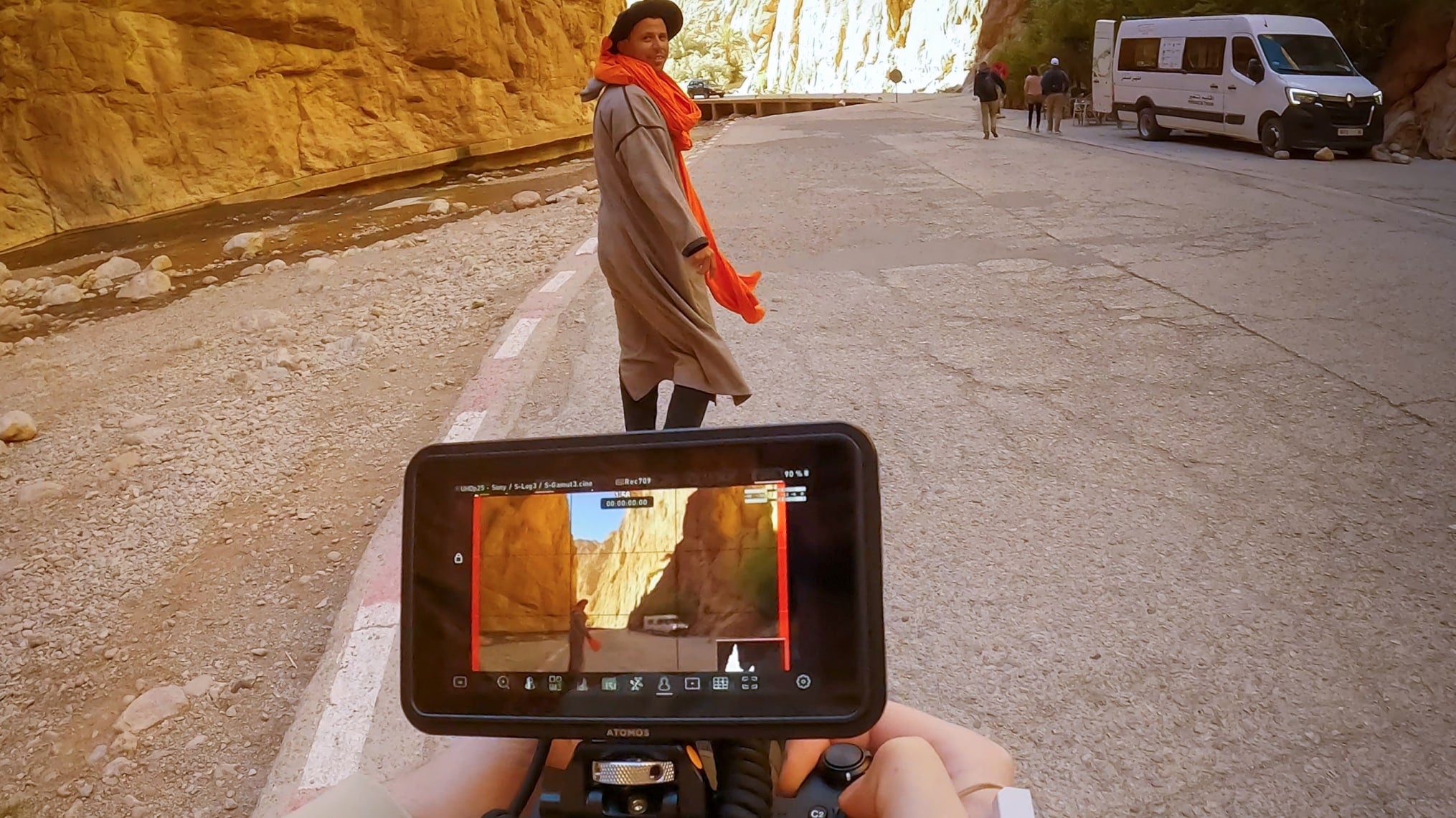
As they moved between the shadows of the Atlas Mountains and the intense brightness of the desert, the pair relied on the Shinobi monitors to maintain accurate exposure and composition. The bright, 1500‑nit daylight‑viewable screens proved invaluable whenever the camera’s internal screen became unreadable in direct sunlight. “When you’re working quickly in the Moroccan climate, it’s almost impossible to see anything on the camera screen,” Pascal said. “Shinobi gave us the confidence to keep shooting without second‑guessing.”

Throughout the trip, the monitors delivered a clear and consistent view, even as the light changed constantly. Adjusting focus peaking, zebra levels, and the histogram made it easy to stay on top of exposure. “Whether it was reels, shorts, or classic 16:9, we could already see on set how the image would sit in the feed,” Luca said.

He also appreciated that, despite Shinobi’s wide feature set, the essential tools were always close at hand. “For beginners, the menu can look complex at first, but the bottom menu bar gave us quick access to the most important functions,” he explained. Before long, navigating the display became second nature. “With Shinobi, you’re able to focus on the story, while it takes care of the image.”

“Shinobi gave us the confidence to keep shooting without second‑guessing.”

Although Shinobi II and Shinobi GO share the same size, brightness, and core monitoring tools, Pascal and Luca found that each one excelled in different scenarios.

Designed for creators on the move, Shinobi GO became their go-to for run‑and‑gun shooting. “If you need a bright, dependable image for exposure and framing, Shinobi GO gives you exactly that in the lightest package,” Pascal said. “From weddings and events to documentaries and corporate work, it offers essential monitoring without adding weight or complexity.”

For more controlled setups, Shinobi II offered deeper functionality. “If you want your monitor to double as a remote head with touch-to-focus and camera control, Shinobi II is the better fit,” Pascal explained. Being able to adjust exposure and trigger stills directly from the monitor made it ideal for interviews, gimbal work, product films, and self‑shooting. As Luca put it: “If you want to optimize your shooting flow, the difference grows with every take – and that’s where the Shinobi II really shines.”

Across dunes, gravel plains, and extreme heat, both filmmakers found that the Shinobi monitors didn’t just withstand the desert, they improved the experience of shooting in it. “If you need a bright monitor, Shinobi delivers,” Luca says. Pascal agreed: “No matter which one you choose, you’ll always have a clear view of your image.”

Learn more about Shinobi on our website

SHOP Shinobi II

SHOP Shinobi GO


Keep Exploring

Case Study

Capturing cymatics with Shinobi II

Case Study

Keeping it real

Case Study

Shooting the big event with Shinobi II

Join the Atomos Community!

Sign up to get the latest Atomos news, filmmaking tips, firmware updates, and early access to new products and cloud tools.

You can unsubscribe at any time. See our Privacy Policy

Atomos shop is now available in Australia, EU, UK & USA.
Free Shipping for orders over $70!

For a reseller in your area, see here

Select your country